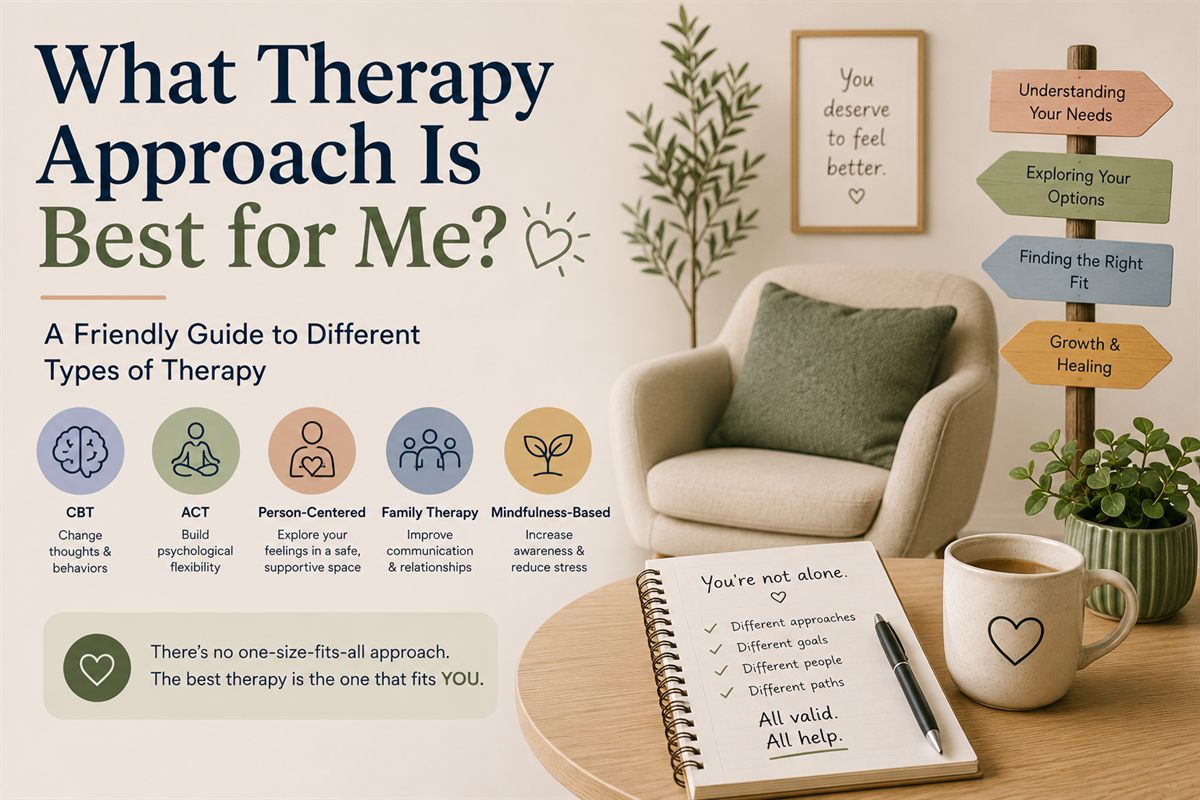
If you've started looking into therapy, you may have run into a wall of acronyms, CBT, DBT, EMDR, ACT, IFS, and wondered whether you need a degree just to choose a therapist. Take a breath. You don't have to decode all of it on your own, and you definitely don't have to get it "right" before you begin.
This guide walks you through the most common therapy approaches in plain language: what each one is, what it tends to help with, and what a session might actually feel like. By the end, you'll have a clearer sense of what might fit you, and you'll see why the type of therapy is only part of the picture.
Decades of research point to a surprising conclusion: the single biggest predictor of whether therapy works isn't the specific method. It's the relationship between you and your therapist, feeling safe, understood, and able to be honest.
So while it's worth understanding the different approaches below, please don't get stuck trying to find the one "perfect" modality. A skilled therapist you trust, using an approach that's reasonable for your goals, will almost always serve you better than a "textbook-perfect" method delivered by someone you don't click with.
The idea: Our thoughts, feelings, and behaviours are connected. By noticing and reshaping unhelpful thought patterns and habits, we can shift how we feel and act.
Often helpful for: Anxiety, depression, panic, phobias, stress, and situations where you feel stuck in repetitive negative thinking.
What a session feels like: Structured and practical. You might track thoughts during the week, test out new behaviours, and work through specific exercises. It's collaborative and goal-focused, often shorter-term.
The idea: Built on CBT, but with a strong focus on accepting yourself and working toward change at the same time. It teaches concrete skills for managing intense emotions.
Often helpful for: Big emotional swings, self-harm urges, relationship difficulties, and feeling overwhelmed by feelings. Originally developed for borderline personality disorder, now used much more broadly.
What a session feels like: Skills-based and supportive. You'll learn tools in four areas, mindfulness, distress tolerance, emotion regulation, and interpersonal effectiveness, and practise them in real life.
The idea: Our present struggles are often shaped by past experiences and patterns we're not fully aware of. Bringing these into the light creates lasting change.
Often helpful for: Long-standing patterns, relationship themes that keep repeating, low self-worth, and a desire to understand why you are the way you are.
What a session feels like: More open and exploratory. There's less structure and more space to talk freely, notice connections, and reflect on your history and relationships, including the one with your therapist.
The idea: You already have the capacity to grow and heal. The therapist's role is to provide genuine warmth, empathy, and acceptance so that capacity can come forward.
Often helpful for: Building self-esteem, navigating life transitions, self-exploration, and anyone who wants a non-directive, deeply supportive space.
What a session feels like: Warm and led by you. The therapist follows your pace rather than steering toward specific techniques or homework.
The idea: Instead of fighting difficult thoughts and feelings, we learn to make room for them while committing to actions that reflect our values.
Often helpful for: Anxiety, chronic pain, depression, and feeling trapped by your own inner critic or worries.
What a session feels like: A mix of mindfulness, metaphor, and values work. You'll clarify what truly matters to you and take steps toward it, even when discomfort shows up.
The idea: Distressing memories can get "stuck." Using guided eye movements or other rhythmic stimulation, EMDR aims to help the brain reprocess these memories so they feel less distressing.
Often helpful for: Trauma, PTSD, and specific painful memories that still feel raw.
What a session feels like: Structured and specific. You'll briefly focus on a target memory while following a back-and-forth motion or tapping, then notice what shifts. You stay in control throughout.
The idea: The mind is made up of different "parts", like a protective part, an anxious part, a wounded part, all trying to help in their own way. Healing comes from understanding and caring for these parts from a calm, core "Self."
Often helpful for: Inner conflict, self-criticism, trauma, and feeling pulled in different directions.
What a session feels like: Curious and compassionate. You'll get to know your inner parts without judgment and help them feel less burdened.
The idea: Rather than digging deep into problems, focus on what you want more of and the strengths you already have to get there.
Often helpful for: Specific, well-defined goals and people who want practical results in fewer sessions.
What a session feels like: Forward-looking and energizing. You'll imagine your preferred future and build small, doable steps toward it.
The idea: Sometimes the focus isn't one person but the relationships between people. These approaches work with the patterns couples and families fall into.
Often helpful for: Communication breakdowns, recurring conflicts, rebuilding connection and trust, and navigating big changes together.
What a session feels like: Everyone has a voice. The therapist helps the group slow down, understand each other, and build healthier ways of relating.
You don't need a definitive answer before reaching out, but these questions can point you in a helpful direction:
It's also completely fine to say, "I'm not sure, I just know something needs to change." That's more than enough to begin.
Here's something many people don't realize: most therapists don't rigidly use just one approach. Many are integrative, meaning they blend methods to fit you rather than fitting you into a method. Part of a good therapist's job is to help match the approach to your needs and adjust as you go. You can see the approaches we draw on and how we work if you'd like a sense of our style.
So if all of this still feels like a lot, that's okay. Choosing an approach is a conversation we can have together, not a test you have to pass beforehand.
If you'd like to talk through what might be the best fit for you, we'd be glad to help. There's no pressure and no commitment in simply reaching out, you're welcome to book a free consult for a relaxed chat about what you're looking for, or learn more about us and how we work.
Choosing to start therapy is a meaningful step, and you've already begun by reading this. Whenever you're ready, we're here.
This article is for general educational purposes and isn't a substitute for personalized advice from a qualified mental health professional. If you're in crisis or need urgent support, please contact your local emergency services or a crisis line in your area.
Mindful Connections Therapy
Book a free 15-minute consultation. No pressure, just a chance to see if we are a good fit.